Showing posts with label cycle of life. Show all posts

Saturday, April 21, 2012

OUTLIVING CHILDREN (acknowledging that the Earth is one of this Universe's children)

OUTLIVING CHILDREN (acknowledging that Earth is one of this Universe's Children)

Very sad indeed for parents to outlive their children.; Something happens to the generations that should not. My paternal grandmother outlived most of her ten children, and for a while, it looked as if my mother might outlive her only child. Fortunately for her, i'm still here alive and ready to try to accomplish more than ever (ideally driving). If not, there are other ways to assert a meaningful presence. For me: limited fork ways.

With all the (rather frequent) tornadic events in the US in 2012, such outliving must be more common, if not more natural. Wars contribute to this dreadful phenomenon --pur DNA supports conflict, or we'd have evolved without it. I feel like adding my tears to buckets and barrels of tears --not that my additional tears would help anything, but I still crave such addition --some form of math seems involved, so far, with everything, not that human forms of math are the best or only forms, but as part of humanity, I will continue to submit to them. I must rely, as I've always done, on human senses, the only senses I have --even humanity's instruments improve what humanity can see, hear, touch, etc. I need an equation for tears, but when I add tears, I just get more tears. I do fear that there might not be enough fresh water (or food for populations of Earth, and I do not feel that humans are not more deserving of food just for being human --I doubt that, were other animals in charge, the Earth would be experiencing this decline this fast --some of my assumptions surely show here), and tears tend to be incredibly fresh when produced, so my tears --they aren't too salty to be fresh-- can add a minuscule amount. I can't cry enough for everything. And looping bifurcating systems may not offer enough to constitute salvation --even if all possible loops are formed. Million of forks, for no reason but to make art that possibly no sentient one will see. Not that humanity's seeing it makes it any more splendid (note the assumption of splendor --humanity's Hubble space telescope did not make things easier for me; increased, actually, an accessible amount of splendor.

A time may come when dependence on tears could make a life/death difference --not necessarily a splendid difference.

I definitely do not wish to outlive my son. He must go on to live a full life, one that rewards him with joy (however he eventually defines joy). what successes, generations --if the world lasts long enough. I am optimistic that the Earth will/can endure. For my son, and sons of my sons. Surely, I hope long enough for his life to matter to more people than me. But then again, I am not promoting an afterlife such as what I was taught about so long ago. My mother still insists that her Christian beliefs are the correct beliefs. But I think that what is thought to be known (what I've been taught, and what I've observed at planetariums and through telescopes [I've been ruined, it seems, by Hubble]) about the universe and the solar system cause me to doubt her beliefs. She tells me that the prayer chains she initiated while I was hospitalized affected my outcome --I cannot say with certitude that all that praying did not help, but I wonder about what happens to the body; decomposition seems quite likely to me. Houdini did not return, and I believe that he would have had return been possible. Humanity's atoms may become available for next forms of life, assuming Earth can continue to sustain life as we've known it --not because we have dominion over other lifeforms, but because

I hope we have a chance to improve the earth (assumption that improvement is needed: noted), to try to return it to some of what it was like during days before greed --that benefitted a few, not everyone-- helped to deplete the planet of finite resources. I do not think that we have suffered through all that will have to be endured before planetary decline can be halted or, better, reversed. Maybe it's too late for reversals. Maybe humanity does not deserve reversals. But I also don't want belief systems of humanity to perish --all that believing must not have been for naught. Surely. I don't want human generations to have an abrupt ending, but such an ending may be inevitable. There is interconnectedness among species. As insects and amphibians, for instance, meet demise, lifeforms dependent on those insects and amphibians may perish from those extinctions. Not to mention possibilities of asteroids and comets that may have deposited building blocks of life on Earth --comet Gods, I guess.

I'm not sure how my grandmother coped with being here after so many of her progeny (she had ten children, outlived all but three) were gone, returned to earth her husband tilled for so many years. A southern farmer. She outlived him too. I used to play with their geese, many of which were as tall as I was. He was dead already; never knew him except for what survived in my father and what was passed on to me through him. I've passed along some of what I received genetically to my son. Half. Lately, I've been impressed that everyone alive now has roots that extend to the first people on this planet. This seems to offer a truth no matter what is believed, creationism or evolution --of course, I thought that Darwin also offered a truth, seriously questioned by the Scopes Monkey Trial --in Tennessee, of course, where my father grew up and met my mother who now rejects everything I was taught in Cleveland, Ohio public schools, but not what I was taught in Sunday school. She is converting the garage into a church (it is not going to become the dolphin tank that my father promised, except in dreams and imagination that would not be mine had he not made the promise). My mother was always with me while my father stayed home, often on the second floor porch, watching, once, me by his side, a funnel cloud form above the church just a few yards away. True Vine. My son was not raised in church as I was; he was raised more to be a free thinker, encouraged to form his own ideas based on what made the most sense to him, and it is not organized religions. This exclusion from church has helped him rely more on logic --another human invention. How can humans not rely on human knowledge systems? Are we not surrounded by what humanity has made, whether for the detriment (according to someone's assessment) or improvement (according to someone's assessment) of human lives? Are we not primarily concerned with what may happen to people? Animals primarily as pets and food --for humans? I think of zoos, though I've visited many, as comparable to what happened in slavery, the captures that separated families --when animals are captured (I won't even talk about what happens to animals raised to be human food --no other purpose, the most noble purpose, according to Babe, book by Dick King-Smith, screenplay by George Miller and Chris Noonan --I do eat meat, the sanitized [relatively] forms purchased in supermarkets, relying on others to do the killing and butchering and packaging for me. I do like tastes of meat, and I do experience misgivings about being the carnivore I am, criticizing no carnivore for their carnivore ways --that I share). There is hypocrisy here --how can there not be? I am human-- I've admitted to eating meat, but I've rejected organized religions (many of which restrict the eating of meat to certain animals under certain conditions [of preparation] without outright prohibiting such consumption). I do not know all of what Buddhism teaches about the eating (or the not-eating) of meat, (go here http://mingkok.buddhistdoor.com/en/news/d/18354 for more info), but I reason that we should, even thinking of limited fork tenets, show more compassion toward other animals to whom this planet belongs just as much as to humans. I don't accept biblical teachings of humanity's dominion over other animals or over the world --planet. Exceedingly difficult for me to do that. Other animals may not have been as destructive as humans have been. I seem to take more outrage against those who are not free- thinkers than against carnivores; perhaps because I also think that meat-eating free- thinkers may have reasoned that eating meat is acceptable --I am from a family of carnivores, the human family as well as my personal family (my son was vegetarian until ninth grade and a field trip to Chicago where he ate a burger for the first time).

I don't know whether or not the sacrifice of the cow entered his mind (he is a member of Mensa --not that that membership means he is more or less likely to eat meat; he's also a member of the human family, and, as I've said, we haven't performed particularly well, given our responsibility for the planet --we are the planet's [self-appointed --made in God's image, according to many, including my mother] caretakers). A willing or forced sacrifice? What do we know or understand about cowness? How many of use have really tried to listen to what cows or other animals (including humans) might have to say? Does this understanding or lack of understanding really matter? As humanity runs out of what humanity, in any of its forms, considers food, perhaps this (and similar questions) will be answered. It doesn't really matter which questions are raised or attempted to be answered according to human ways of processing information --biblical or otherwise acquired-- ways of determining which questions to ask in search of a truth accepted by all with liberty and justice-- hmm; I've heard that before. Even had to recite that daily to get the "A" that I wanted (from the Declaration of Independence --not a declaration of free-thinking)


Take a look at "Outliving Children."

Saturday, April 7, 2012

Hello to my Toledo Friends!

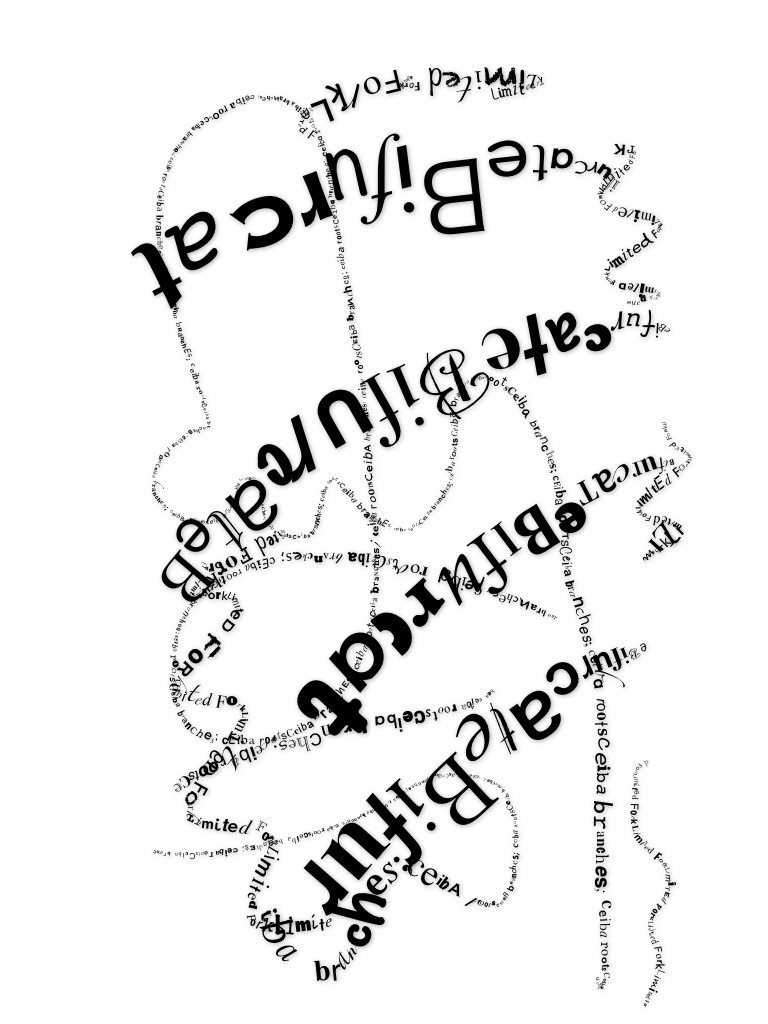
Let us bifurcate together and dine on wonderful ideas; we will bifurcate above and below ground,
rather like trees, anchored with roots that cling and spread in soil
while our branches spread even between dimensions, temporarily connecting them
-–I don’t think that any connection is or can be permanent; that is one reason that we must eat again and again (ideally stopping when we feel full, even though the feeling of fullness is temporary).

We will hunger again. Everyday. Probably several times a day.

Please think, if you don’t mind, for a moment of ceiba trees, or of any tree you have liked –-forgive me, please, for assuming that there is a tree you’ve liked. If you dislike trees, this may not be a post for you, but I leave here a small interest in trees, a small interest that may become something else.

Each tine of a limited fork also functions as a root and/or a branch and may curve, circle, disappear for a while, temporarily connecting things, possibly even snagging something tasty, something possibly nourishing, something that can be ingested –-maybe without harm(ing us), but what is ingested will change during this process, and we may change, so the temporary connections is also a means of exchange: we give something and we receive something; we may not realize immediately that we are different, but we are.

Tuesday, February 21, 2012

Slavery (more legacies of)

More Legacies of Slavery


Slavery was (is) so much like what has happened (is) happening with credit now --to credit and to citizens. Credit card companies own (most) of us. Every day, my inboxes fill with offers to provide me with credit scores, and/or additional cards. Switch! (I'm encouraged).

To speed up shopping, link a card to your account, tap and go! Meanwhile, those at the top are getting richer and richer, and those at the bottom seem to get poorer and poorer, resulting in a vanishing middle class. The gap between the top and the bottom is widening --I hope you like what you're born into, because moving out of one designation and entering another will be difficult (at best).

As I write this, I'm recalling when (some, not all) women got the right to vote --not as impressive to me, perhaps because of (some of) slavery's legacy: seemed just right for women, from that tradition, as women (from that tradition) had always worked --after all, slavery was an (economic) path to getting labor done --an economic path with racial barometers and barriers.

For enjoyment, I read When They Were Girls; the they included Clara Barton and, a personal favorite: Susan B. Anthony. Perhaps because of my father's pale coloring, that book was magical to me, anything that applied to him, I figured (still do) also applied to me, but I was wrong (still wrong) about that. I failed to understand that Susan might not be working on my behalf. She (in pictures I'd seen) and my father were a similar color --they looked the same.
I come from a household in which my mother and father always worked, so it was not strange to me to be left at home, alone, while adults worked --no matter the job, I was left to my own devices, usually reading and writing till my parents returned. I started writing at age six. The legal right for women to vote was granted in my mother's country (also mine) in 1920, via the nineteenth amendment to the US constitution. But as a woman of color, she had to wait longer to exercise that right. Slavery, in essence, was extended (even to now --in many ways). Post-reconstruction America, was not a hospitable place for the variety of citizens (still true, especially if animals are included --it's their planet, too) that lived here, then and that live here now.

Please read more about the USA's history of low tolerance for racial equality here: (http://www.pbs.org/wgbh/aia/part4/4p2957.html). Read more about some of the history of black exclusion from home ownership via exclusion from bank loans here: (http://en.wikipedia.org/wiki/Mortgage_discrimination).

--such reading can help to change a mind (such as mine) about affirmative action (which has probably) helped me, and is probably still helping me: as I think about policies based on (or rooted in) medical discrimination, especially against those with physical and/or mental abnormalities and/or anomalies. While not at the bottom, I don't believe (except for perhaps in remembering --no more mental math team for me, I guess!)
I am not at the bottom, either. I can still both teach and write, but with more compassion for those excluded from these ranks. I am a better person (seems better to me) because of what I've survived, and the ways in which this survival is manifesting itself. (--would be better, perhaps, if not for the banks.)

I do feel enslaved to banks --and to credit card companies (who really own me). My car is mine, however, paid for in its entirety (but, being a 2004 Nissan, the car does require maintenance, that I must pay for --often with a credit card, so until that amount is paid off, I suppose I don't really own my car --and as balances get too low for the lien holders, I get offers to go into more debt, possibilities of reverse mortgages, etc. (now that the house is nearly paid for) and a general lack of empowerment for me who is not a corporate leader, who owns no valuable stock, and who is not invited to the meetings where decisions are made. I pass nothing on any sides of tables (but I do have to report injuries, --my prior medical conditions-- when asked by companies about to make some decisions I'll have to try to live with --oh my numbered days!)

There was a time after slavery ended when blacks still had no rights, still lived without any real ownership of their lives, couldn't make legal decisions that would be upheld wherever they went --even within the country, south to north, east to west, etc. (Still a problem for the bi/multiracial and the gays & lesbians in various parts of the world.) Religions have made acceptance more difficult, not easier. It seems logical, for instance, to construct a brown Jesus. Would He not be the color that people from that part of the world tend to be? Our recent enemies from Iran and Iraq? Brown --a dominant skin tone (darker than my own father). The most violent forms of aggression against minorities seem to have ended or seem to be ending. There will, likely as long as there are people, be pockets of violence filled with people who take out their fears and animosities on others. An end of aggression is not upon us, despite turning the other cheek. It seems likely that lynching was an outcome of an end of a terrible system that persisted in the new (not really that new) world longer than anywhere else --and now enslaves us all.

My maternal grandfather was murdered, perhaps lynched --this isn't talked about much; hardly ever mentioned. His absence has been felt; however. He is enigmatic; a person of imagination, not memory. And he is one of my antecedents. --I came here by way of shadow and absence-- Incredibly shadowy --as a lynched figure would have to be.

I am beholden to companies with lots of money, bank wads (--I know that Nene is rich, but I don't know Nene--), the ones really responsible for my having the stuff I consider mine (could be stolen at anytime --hope not, however). Some of it, I've had so long I no longer fear a corporation taking repossession of it (again: could be stolen at any rime, but then wouldn't be mine tom worry about theft might help get me off the grid where none of this would matter, including blogs and websites --where servers are maintained by others, including the corporation --what I consider my work depends on them).

The house (in need of repair), provided I can hold onto my job for (at least) another five years, will be ours (I've been married almost 40 years) --no more mortgage then! Some (all Jehovah's Witnesses) of my friends --one of whom would have made a superb French teacher, were not supposed to go to college because the world was supposed to end before their graduation --in the eighties. But the world is still here for now --I don't know for sure how long--who does; even those who claim to know have based this knowledge on human perception --which remains problematic.

For how much longer, no one can say with certainty (--this planet is as vulnerable as any other cosmic object); and right on Earth, we've got climate change and its effects (poor polar bears), those wayward asteroids and possibly a return of a comet that took out the dinosaurs (the Earth does indeed have some craters. Click on this link for a list, each item of which is also clickable: http://en.wikipedia.org/wiki/List_of_impact_craters_on_Earth). It shows, what I believe from what I was taught and what I've been exposed to (what I haven't been exposed to has not had an opportunity to influence me, but if LFT is correct, then such opportunities might have a chance to occur before what we believe is here --according to unreliable human perception-- is gone).

Of course, we are capable of annihilating ourselves (hydraulic fracturing may assist with a process of annihilation --but may not-- contribute to an ultimate demise that seems rather definite to me. I doubt that humanity will last forever (Limited Fork Theory is all about strategies of doubting; connections could be made in doubt as well as in affirmation). So far, lasting forever has not been a tendency of any terrestrial inhabitants --why would it/should it be different for humanity? For human beings? I don't think that we are special, no more so than anything else alive. Aren't we just parts of other species in a long chain of life? Chain is significant, I hope, calling to (some) minds those chain gangs --and a song by Sam Cooke, released on an album: Wonderful World --an album where the rights belong to (Cooke's first single for RCA):

The Corporation.

Clicking on this link (http://en.wikipedia.org/wiki/Chain_Gang_(song)) will take you to more info about the song. There are, of course, other songs about chains, but the focus is on the song named.
Click on this link (http://gerryspence.wordpress.com/category/corporate-slavery/) to read more about how we are corporate slaves --slavery that is a part of, it seems, citizenry (in this democracy --built-in slavery, built-in like appliances also made by corporations. One of the flaws of democracy, that many of us think of a form of (political --to differentiate it, as much as possible, further from religious) salvation. Our money does say: in God we trust.

Sharecropping

Quite an insidious system. You never own your little agricultural plot; takes an incredibly long time to buy off your family. You're encouraged to plant, plow, harvest, but progress is difficult (at best) to measure. This link: http://en.wikipedia.org/wiki/Sharecropping takes you to more about sharecropping as Wikipedia reports it (I like how Wikipedia is an aggregate, relying on the knowledge and accountability of users --I see no reason not to trust this user-based system of info dissemination --I've been taught to trust the Bible and encyclopedias --Wikipedia is an encyclopedia, but one that constantly accepts info as info become available; it self-corrects, and expands, grows as humanity grows, --is as trustworthy as humanity is-- Wikipedia bifurcates, is a bit of LFT in action). Cotton enters here (again): the touch and feel. The fabric of our lives. Please visit http://www.lex97.com and watch the T-shirt skeletons movie, on the website: lex97 and on YouTube: the forkergirl channel.

- Posted using BlogPress from my Limited Forked iPad

Location:Michigan

Wednesday, February 15, 2012

Hello, Thank you for joining me on a trip to: The Library of Failed Tastes Where We Read Jorge Luis Borges as an Ice Cream Cone that Gives Shape to Pinheads who Want to Be Heroic


Untitled Document

We are quite fortunate to have such a library.

You may sleep here. Under these blankets, it seems there are only nursing
camels; what protrudes to be humps of transformation expand and contract like wooly lungs, the mounds of respiration. This is sacred now, because of problems with air, fear of taking a breath yet having to because the respiratory system is slow to change compared to the need for it to change.

Those who come here crave the tactile, these old pages flake upon contact with our fingers. As if we process tobacco, believe in native trades again too late.

I don't know that depending on speciation will get us here, but were we camels, we would not be who we are now; we can remember a future we make of dromedary; hope (why shouldn't a camel have a turn at being savior outside deserts?), but the future won't need to resurrect us if it plans on going somewhere better which is how we got our dromedary destiny. There are books about this, but mostly abstracts.

Perhaps you are familiar with the

universe; that is an indeterminate number of galleries in the Library of Babel; perhaps you know of it and other
exquisite failures, many of which are also poetry. Failures I interject now, mindful that anything happening that is noticed is as interjection, arriving at oblique angles, able to disrupt so as to cause notice after which the event, transcribed into symbols and alphabet of memory, merges into pages of time and existence, and the infinity, always infinite continues to be infinite though now is made of more pieces so is a larger infinity though the hands involved are those of

Jorge Luis Borges, for whom I imagine an ancient beast of typewriter, paper eating-insects with mandibles carved into the shapes of the characters, especially (I am attracted to this one) the ruined smile of tilde, insects that the writer feeds by typing The Book of Sand, the insects biting the words into the paper. It is quite beautiful really (a replacement revelation for the much older one on Patmos that is so famous it no longer works for me), except perhaps for the fastening of the insects (at the thorax) to the typebars, leaving their legs free to conduct only the music of frustration and desperation, music easy for some to not hear, but that music, even if beautiful, as suffering can be in how it perfects some (many of the Patmos-committed) for salvation, establishes worthiness, is christlike and beneficial, is SOP in nonviolent protest, is a dignity of aging and degrading infinitely in some infinite systems, in some galleries of the library.

Here is some further more complex beauty: that music of captive insect frustration and desperation, that invisible sonic milk:


(milk for being of tortured necessity, as when birth occurs as rebellion against circumstance, when there are hostages of human inability to figure out what to do with variety so overwhelming in its apparent endlessness, a slap in the face of the conformity that more easily could support the bland harmony of consensus); that sonic milk is overcome by using manicure scissors that have a blunt rather bulbous tip somewhat like the tip of mouth of a bottlenose dolphin that can also be made to perform —there are books about this in the Library of Babel is inside The Book of Sand (I will try to explain as I give this

Book of Sand
to you), but nowhere in this motel-provided Gideon's Bible something entirely unacceptable to me, so the shortcomings of the Bible are obvious, and persist in translation after translation. But it reflects the knowledge of the circumstances of its writing, including point of view, and maybe, as I have, you’ve had enough history lessons. The Library of Babel inside The Book of Sand must constantly remake itself. That is the advantage of its substance, the sand is easily reconfigurable, the biblical dunes of it like unsuccessful dromedary humps shift, move (alive with insect alphabets), so all information is dynamic, and has memory so can return, only for a limited time, to a prior configuration for comparative studies and both healthy and unhealthy forms of nostalgia.

I’m sorry to have said all this without first saying hello, but I’m so eager to give you this
Secret Books before it turns all to sand for another reconfiguration. And I want something of this exchange in this motel (somewhere in either forms of space, cyberspace, through a trail of IP addresses leading to, ultimately, a location [unnamed deliberately] where this would be banned, and physical space where we spiral along in the arm of galaxy whose central engine might be a supermassive black hole: a form of quantum quicksand) to appear not quite legal yet be thoroughly ethical. Hello. Take it. My hands are cupped around it as if I prevent something from flying away and in the act of prevention experience a mildly abrasive pleasure as insect wings vibrate and scrape my palms, erasing one fortune and replacing it with another, each replacement increasingly more accurate as time takes me closer to inevitability. In my hands, the words bitten into paper are insects themselves, have grown from eggs deposited in the bites when Borges typed because, and have hatched winged with an epidemic of possibilities. Nothing infects the library more, and when the sand hatches, perhaps it will be clearer that somehow the library already contains all books written and all books to be written, it is a library of all possibilities of alphabet inside
The Book of Sand. Embedded in the alphabet is the possibility for all words, all sentences, all books; a matter of configuration and adjustment —that’s all. That’s why I give in this one book (translated from Borges’ Spanish by Andrew Hurley) every book. The Bible has but 66, impressive to some, but only 66. And it is bound. What I give you is unbound. Unfettered. Look at this page of it that is also an ant farm habitat in The Secret Books, a photographic translation of The Book of Sand and other
Borges; writings by Sean Kernan (look quickly; I do not have permission other than necessity to give you any but a limited [what they all are in a truth this library understands] look, a limited exposure): Also look at
Strawbridge

Eileen Joy; teaches, has taught such work also.

from Amazon, this:


I would have cut out the words, and used them all as fruit to attach to branches of miniature trees (alternate display mode for insect collections) I would have made out of the pale beige paper backgrounds returned to pulp in a cheap blender (so that the paper would look as if I’d chewed it [my inner insects active from so much reading] to extract the juice of information, a diet of a potential for poetry present in alternate arrangements of words that chewing itself might accidentally and temporarily locate). Surely this is connection to wasps whose books are hives, whose library is a corner of my garage.


Sean Kernan - The Secret Books

I caution you that in the infinity of the Library of Babel inside
The Book of Sand, every language is encountered; pages and pages, volumes and volumes in the language of the Voynich Manuscript of which what I’ve written here is a failed translation. Some purpose (the portion that approaches an unattainable noble elevation) of metaphor has been to teach appreciation of failure, the joy of the blessed inexactitude that is translation, the little useful mutations that occur in approximation, sponsoring evolutions. Let's say that
a model of this universe; is as a series of umbrellas opening inside another, stretching, elongating this universe into, what amounts to, a series of universes. Let's imagine an opener --perhaps you (why not?) --or forkergirl, if you prefer (or even if you don't --could be that forkergirl spends her time opening umbrellas) as when she imagines universes; as places to go.

The first place that I could go to alone was the

library; when I was seven and still in the city into which I was born. I thought of the building on Superior Avenue as a book itself monster book whose windows were compound eyes and whose ornate door was a mouth. It wanted to consume. As do books. Mutual consumption of reader and reading material. Don’t be deceived even by forms of books whose volume seems measurable. A certain number of pages, deceitful numbers doing their job, pitiful as it is in infinities where much numbering is cosmetic, for you may turn to any page even when pages are apparently finite —and how that finite number of pages is experienced may be infinite also. The materiality of pages seems determined, yet over time will degrade: pages will become as sand, as fodder for hourglasses, my Pretty. That too is translation. Even on presumably static pages: words that move; my ideas open them, twist them, unfold them (sometimes in a scene from The Silence of the Lambs; where I too am crime-busting entomologist) and continue unfolding what has been unfolded, the page able to accommodate eruptions of additional story-mass, extended continental ant farms where, on some of them, quicksand emerges.

This happened even with the Bible. I couldn’t keep other books out. Right in the middle of
David and Goliath
David and Goliath were passages about the Princess and the Goblin, the Princess and the Pea. And while the ark was afloat, there were mermaids and dolphins becoming interchangeable silhouettes in moonlight that kept writing fictions inside gospels. Glorious fictions including the most glorious: Borges’ ficciones.

What I really give you is the Book of Quicksand. I hope that in accepting it, you’ll be sucked into its endlessness where I am. The sandstorms are pure seduction. I’ve not experienced quicksand other than observing it in Tarzan movies and in books where lines of text become segments of vines easily entangled with Harold’s purple crayon line

(Harold and the Purple Crayon by Crockett Johnson;) and all other veins and arteries. A haven of
blood-suckers. I spent the night once in Virginia in the sitting room of a bed and breakfast house with only books and more than fifty, it seemed, eastern blood-sucking conenoses as bibliography and footnotes. They (related to this one from amazingdata.com) came in through the compound-eyed windows that I couldn’t close. Not to mention the tantalizing scant movements of gauze curtains of lashes. You won’t drown in this quicksand except in imagination, so don’t construct a drowning scenario if you don’t want to drown, but construct it well if you do. Quicksand offers an apparent change in volume by messing with solidity, spreading out colloidal welcome mats in a warping of solidity in which the Book of Quicksand becomes a shuttle into and out of arrangements of infinities (possibilities) of the Library of Babel inside it.


Every word, every letter is a
a trapdoor;. Every idea is quicksand.

And a hot desert, sooner or later, with all that sand, has access to the most heaven.


Tuesday, February 14, 2012

I'm Still Here

Whitney's gone, but I'm still here
(hoping to take advantage of this gift)

(--maybe the world needed or wanted Whitney more --
but she is gone, and I remain to do what I can --but I can't sing as she did, certainly not at the peak of her career in the 80's and early 90's, but perhaps I'll do what I can --what more or else?  I expect to fall short, human that I am without choice or argument).

Whitney's gone

(but I'm not, not that our lives should be conflated;
I would/will disappear without fanfare or even notice beyond my family & employer, maybe a few friends from neighborhoods where I've lived; a handful of doctors who may still wonder a bit exactly who I am/was).

What should I do with this  extra time that is mine
--not that I really believe that I have extra time;
I don't think my time on earth has lengthened; I don't think that suddenly I have skills previously lacking, but I can see (a little) more of my son --I hope at least another 20 years though the world may be gone, and I may have entered another dimension presently (though not necessarily forever) inaccessible from here.  Perhaps climate changes will make the planet inhospitable to life as humanity has known it and has come to expect it (with some religious-based differences).

Will there be enough food and and clean, fresh water?
Something that has led to me has been here since life on Earth began, so I may have descendants who will struggle  to survive (along with all other lifeforms), but the easy ride (fortunately, humanity did not have to share this world with dinosaurs, but recent work suggests --pretty much confirms for me-- that birds are descendants of dinosaurs and that some of these past  lizards may have been feathered --the male t-Rex may have been quite a bit more familial --caring, involved with rearing young
t-rexes, etc. He may have stayed with the nest, protecting it, decorating it, etc).  He may have been one of the early gardeners.

I don't know what kind of gardener Whitney was (or in more time would have become).

I am not (never have been) noted for my gardening.
(image from Amazon) --I do have a piece in Colors of Nature, p. 743: Tarsenna's Defiance Garden in which I Love to Spit.

I did receive a small plot to care for long ago as part of the Moses Cleaveland school gardening program).  My mother has performed more admirably with plants; she deserves an award from me (my father is no longer here to award her personally, but she believes she'll be reunited with him --and with all others who have departed
--including  Whitney, Tarsenna, and the dinosaurs).

Monday, January 23, 2012

Here!

Still here and loving it! Thought I would be gone this summer --but defied predictions and expectations to still be here despite trouble in the world and cosmic threats, disturbances --I'm still here (for a while).

Not sure for how long (I certainly don't know why) but I hope to do something to deserve this elongation of my presence on this planet (not to say that I have ni representation at all in other cosmic locations)

Saturday, May 21, 2011

Dove Fish in Stone Gathering Moss ( a text poam entree system)

LISTEN TO THIS POST:


_____________________________________________________
Dove Fish in Stone Gathering Moss
by Rita Dove
annotated with a text poam that is further annotated by Thylias Moss


(as presented in Minneapolis, Minnesota at a Rain Taxi sponsored celebration at Open Book (dream store-gallery-book-making-workshop) of the Poetry Society of America centennial, another stab at site specificity, to make connections between that fish, that stone and my aunt, another sibling of the six out of nine that died before their mother from a disease I was told was, at the time, European, as if that part of them warred successfully against the native part whose strength went to their appearance; that's why Blain's is in [tenacity of presence] what follows: a text piece (form of poam) of even more limited applicability than usual, specific to, peculiar to an intersection of all that meets, convenes, converges to mark each other with having come together, some of it forced, then diverges, separates without having to reconnect the same way or at all except for how the marking influenced, steered to some degree, that likely won't be known fully, where participants in the collaboration went, some of it to this blog post, more than a year later [particles of it still pulse while blessed apparent simultaneity echoes of a big banging cosmic event still travel in all directions, determined to connect with us].):


Oleta Adams sings Get Here:

FreeVideoCoding.com
(buy at iTunes, Amazon)


Open Book mapped:

View Larger Map


Dove Fish in Stone Gathering Moss

The fish in the stone
would like to fall
back into the sea

one of many puddles,
billions of luminous cosmic pools
can also fail
in their promise of depth

So much longing


so close to the Farm and Fleet's
assortments of toys, home basics, wild bird care,
cherry life savers as a jazzy set of monocles Belvia often held up
making an oasis of her eyes' black centers' surrender to endlessness,
eleven Farm and Fleet opportunities to get to Coon Rapids
and ping-pong all day with Anoka, the landings of her most beautiful days
splashing a genetic puddle full of only near resemblances
flickering on the water's surface as if nothing is more grand
than to sparkle: say oh and ah to brightness
even if just a single megaton bomb exposing its bubbling--pretty near effervescent
--guts: an explosion of newly forming fins, evolutionary artistry since 1955
how true it is that if you can't find it at Blain's Farm & Fleet,
you don't need it, certainly not to shine

—you see above the fish in stone as countertop,

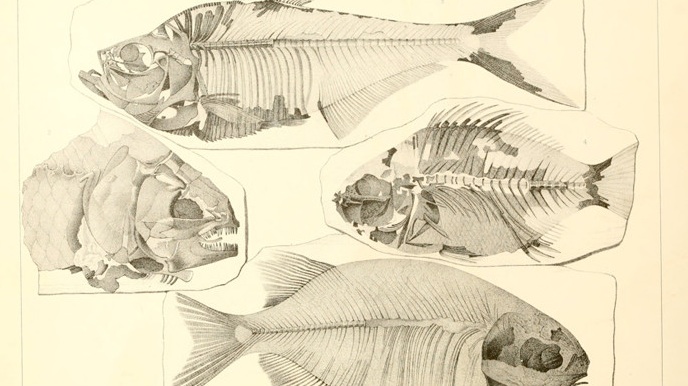
cruelty and kindness of proximity to Kohler styled water that from now on just turns stone more smooth; while I spoke in Minneapolis' Open Book's sea of 2D and 3D print possibilities, nearby in Plymouth, the Green River Stone Company, this image on the left from the web page about them, had already been fishing the shale in a private Wyoming quarry in order to Supply Fossil Fish Murals and Stone Products for Interior Design —Fossil record of evidence of opulence, my onions diced on the complex surface of chances, knife marks and their role models of fossil fin structure make good on parallel worlds. Green River fish in stone escape the wearying analysis to come for the Dove fish (keep reading); these rest pretty
with a hope of mistaken identity as fancy mutant feathers of alternative stone scriptures—


Yes; it could have been routine pistil, stigma, sepal, a week-old petal
mapped with creases of opened origami a net on an Anoka wicker table with Aunt Belvia in cap and gown, highest honors, a picture I could look like,
if drained of just about all my color: I’m Muddy Puddle


[As Walela sings in I Have No Indian Name (buy at iTunes, Amazon), I have no Indian name though I was named by an Indian. There are names for the specifics of my mix, but I don't use them; they don't help me know me better. This I understand (as I did saying this at the Open Book in Minneapolis to celebrate this understanding within a celebration of the Poetry Society of America's centennial): I'm forkergirl of the muddy puddle, the mud and bifurcations helping me slide into and out of a host of inexact translations where sometimes I leave more than I take away, and sometimes take away more than I leave.]


FreeVideoCoding.com

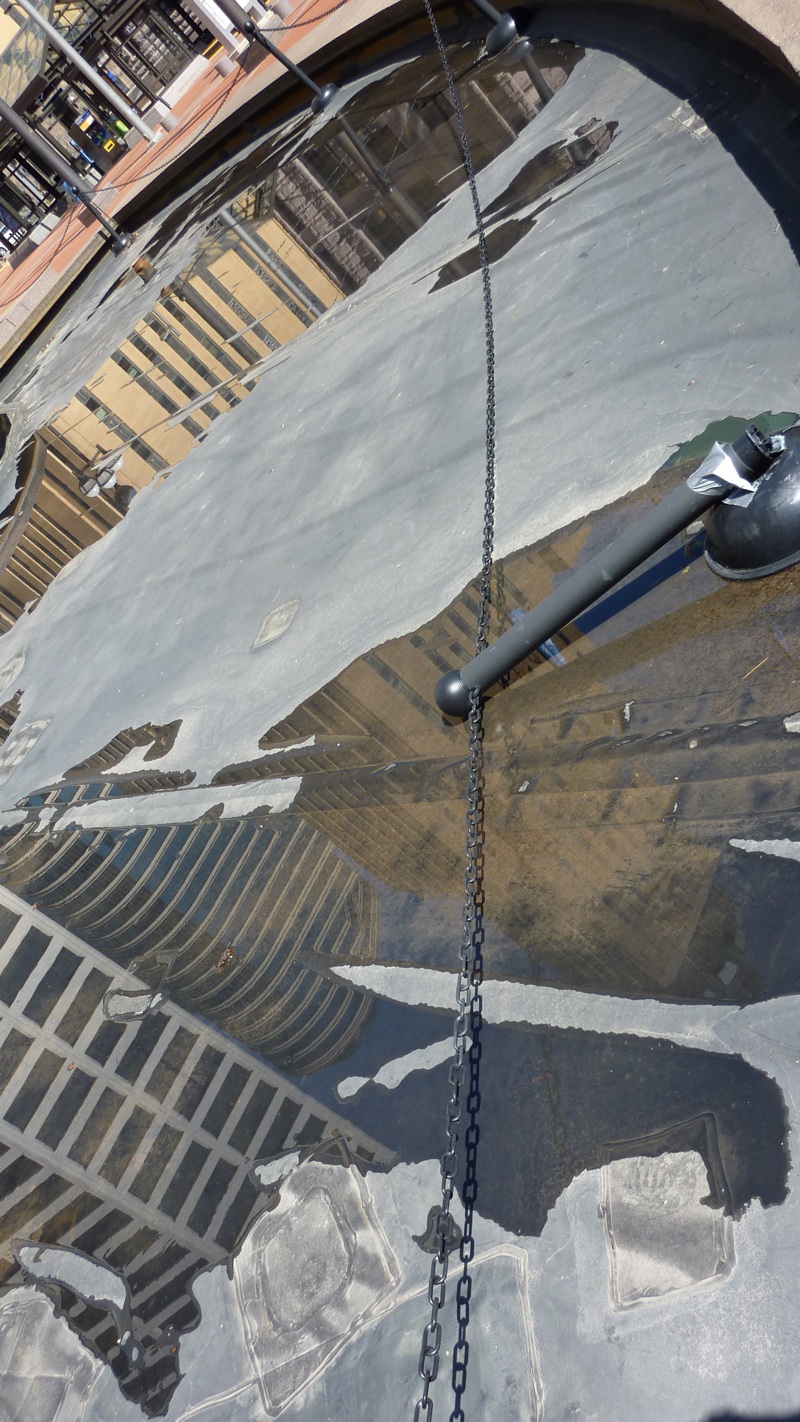
[On the right is an image of a puddle portal in Minneapolis, captured during an exchange between forkergirl of the muddy puddle, light, atmosphere, the amoeba of water (also like the splat of fried-egg-shaped aliens —Denevans— that invaded Mr. Spock who went blind, during the radiation to purge his system of them, until his own alien eyelid raised, taking the blindness with it [mine persists, left eye only —one-eye forkergirl of the muddy puddle ((muddy from a galactic tail being stirred into it before it settles down into a piece of ghetto stained glass.))])


that conceals a mix on an Anoka afternoon, flower drooping
over graduation photo frame like a lamppost trying to inject
its last light into itself leaning against my Coon Rapids aunt's chin's
witness to a fish in stone,
geologic origami folding the planet into a pop-up book:
mountains, silos, and Mount Olympus theme park coasters popping out
like other badly kept secrets of the most powerful trance I know:
Memory
too will granulate, to be flecked and scattered all over the place, universal placement
of constellations, bright enough to fill, but don’t, the universe
of glowing traces of identity my aunt gave to Huntington's,

movement that with enough distance reduces to shimmer:
What every net cast fails to catch.

[The fish] is weary
of analysis, the small
predictable truths

--if only worlds smashed, when a puddle is trampled,
could bleed or trumpet
and not just ripple an attempt to transmit messages
across light years of prairie-flat space

all chokeberried out, replete with Saskatoon berry bushes, needle and thread grass shimmering like fledgling wings experiencing what looks like delight below cascades of brightness rippling over fields as mock swarms of birds changing direction to unheard music, the profound human deafness that confronts most vibration, molecular frenzy deep in the rock stroking the fish, laying down rutted outlines of seismic devotion, held as securely as those in eighteenth century lunatic asylums —what is hungriest there


or just across the reflecting pool on the mall in DC where

He is weary of waiting
in the open,
his profile stamped
by a white light

clean white coats

(image from wikipedia)

In the ocean the silence
moves and moves
and so much is unnecessary!

If we would eat more soup with a fork,
we'd understand that more slips through openings
than tines can, than tines are supposed to retain;
seems we base everything to which we've given a base

on remnants, bits and pieces that shouldn't fit together
because so much is missing;

yet who can deny, lifting the fork
so limited in what it does, sharing limitations of its makers;
who can deny, the fork with its partial catch of fish remnants lifted
toward incandescence and therefore also toward
everything incandescence anoints (we say if we are generous,
anointing things almost desperately, perhaps defending against
there not really being any permanence
or meaning that can come only from that)--

As you move through this life and this world you change things slightly,
you leave marks behind, however small. And in return,
life - and travel - leaves marks on you.
Most of the time, those marks - on your body or on your heart - are beautiful.
Often, though, they hurt

Anthony Bourdain (The Nasty Bits: Collected Varietal Cuts, Useable Trim, Scraps, and Bones)


--who can deny those sticky gleaming bits of translucent fish bits
hanging from fork teeth like jellyfish tentacles
or bleached streamers of antler velvet,
or tatters of flags and banners,
anything can be coveted, taken
to a moment when salvage accrues significance,
anything the fork snares and keeps for just a moment
before those particles of splendid incompleteness fall
through the openings into other unseen, unproven opportunities,
perhaps —I hope so— a meaninglessness which might be the only way
to wipe off all pretense once and for all
uncovering

the moment to cast his fork of
skeletal blossom

stretch mark tines of reach
not cluttered with grasp

The fish in the stone
knows to fail is
to do the living
a favor.

He knows why the ant
engineers a gangster's
funeral, garish
and perfectly amber

unrequited request for sainthood, lack of recognition
keeping the amber coffin free of corruption, sacred impossibility,
antiseptic, sacred vacuum


He knows why the scientist
in secret delight
strokes the fern's
voluptuous braille:

Aunt Belvia's eyelids veined with stick figure statues,
stick figure promises of ho-hum basic stop motion animation
making us weep, simple Jesus remnant
resisting an imprint of the penny's Lincoln Memorial
that made me wish, when I saw it with her,
that palaces were necessary

when anything can gleam briefly,
stellar magnitude
fades during every bright moment,
blasts itself away, satisfied
for having known radiance at all

Good-bye Aunt Belvia

resurrected temporarily in even brighter memory

(is this amber a chunk of wayward flame?
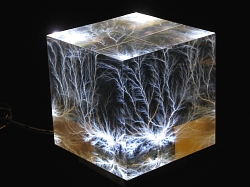
at home beside Lichtenberg figures of captured lightning electron paths
failing to find the god particles they are generating
while bifurcating in Lucite into forests,
each branch a mini big bang, group of revivals, more minor resurrections,
relentless risings, a general upness, bipedalism)


oh, ah, ah, ah

then it's over, a finish the ever-luminous
--even just an idea of immortality--
dulls.